The semester came by too fast.
Half a school year's work culminated during the post-assessment. This session was the least session with our kids, and consisted of a basic assessment packet, very similar to the pre-assessment packet.
I've been worrying about Arvin's performance, but deep inside I knew he would do great. His reading comprehension, as well as following basic instructions and diction had all improved, and I felt so proud as he answered ore than 90% of the questions correctly. At first I didn't think much about it, but when I was compiling all of the lesson plans from this semester, I saw his pre-assessment packet last (my lesson plans are arranged chronologically, with the pre-assessment packet on the bottom) and I saw how from barely 13 letters of the 28-letter Filipino alphabet, he was able to write almost all of the letters in his post-assessment test.
This was his biggest improvement of all.
I couldn't have been more proud as I reverently placed his post-assessment packet in my clear book.
This semester was a very hectic semester, but it was worth all the effort.
Thank you, Literacy Training Service Program, for making me feel like a teacher for just a semester.
Thursday, March 27, 2014

Sunday, March 9, 2014
Lesson Plan 9
March 3 was a big day for everyone in the Literacy Training Service (LTS) Program. That day's session was to be our last session with our kids, and the final two meetings (on the 10th and 17th) were to be devoted to post-assessment. Post-assessment, if you will recall an earlier post about pre-assessment, is pretty much the same thing. We're even using the same pre-assessment packet to evaluate our students' reading and comprehension capabilities, except we'll be using a different story. But more on that on another post!
For the final session, my student Arvin and I tackled the letters 'N' and 'U', bringing our total letter count to 12 out of the 28 Filipino Alphabet letters.
The day's activities consisted of letter bingo, where I showed him different pictures, arranged randomly on a pile, and gave him a goal of forming at least one straight line. When I showed him a picture, his task was to identify the first letter of the word and tick it off on the paper.
As you might recall from my earlier posts on evaluating Arvin, he is a very fast learner and grasps new concepts easily, his one weakness is his rashness and carelessness. When I showed him a picture of a bird, which in Filipino is ibon, he was supposed to tick off the letter 'I' on his bingo card, but instead ticked off the letter 'E'. I pointed to him and asked why he chose that letter, and immediately noticed his mistake. In this I am very lucky, as he grasped how to identify and differentiate the 'E' and 'I' sounds quicker than the other students in the program.
For the final session, my student Arvin and I tackled the letters 'N' and 'U', bringing our total letter count to 12 out of the 28 Filipino Alphabet letters.
"The Roadtrip"
To say that this session was memorable would be an understatement. This was the day we happened to catch two of our classmates riding with our professor (they had just gotten on when we spotted them) and our professor invited us to ride with her, too! (Hello, saved 7 pesos on jeepney fare!)
I took this video to immortalize that instance forever.
Bingo
The day's activities consisted of letter bingo, where I showed him different pictures, arranged randomly on a pile, and gave him a goal of forming at least one straight line. When I showed him a picture, his task was to identify the first letter of the word and tick it off on the paper.
As you might recall from my earlier posts on evaluating Arvin, he is a very fast learner and grasps new concepts easily, his one weakness is his rashness and carelessness. When I showed him a picture of a bird, which in Filipino is ibon, he was supposed to tick off the letter 'I' on his bingo card, but instead ticked off the letter 'E'. I pointed to him and asked why he chose that letter, and immediately noticed his mistake. In this I am very lucky, as he grasped how to identify and differentiate the 'E' and 'I' sounds quicker than the other students in the program.
Narda at Nanding and the Wordless Picture Book
This session's stories consisted of the story of Narda and Nanding, two siblings who live in a nipa hut and go to their aunt's backyard to play, but end up getting caught in the rain and catching a fever. Arvin and I tackled pronouncing and writing the letters 'N' and 'U', with words like 'nipa' (nipa palm), 'ninang' (godmother or aunt), 'nanay' (mother), 'ube' (purple yam), and 'ubas' (grapes).
For the wordless picture book, Arvin was showed a story of a boy who witnessed the logging of a forest, and as a result, when a typhoon hit their community several houses were destroyed and damaged. I was surprised, when, after letting him narrate, he used the example of Typhoon Yolanda (international name Haiyan) as the typhoon in the story.
This week we repeated last week's routine of making our own picture books, even Arvin. I made him draw two scenes from a reading activity and write the corresponding sentence on the blank space provided.
Preparation
Next meeting, on March 10, will be the beginning of Arvin's post-assessment. I'll have to start preparing the lesson and the assessment packet. Wish Arvin luck!
Thursday, February 27, 2014
Lesson Plan 8
February 24's lesson plan tackled the letters 'K' and 'E'. I'm thankful that the letters 'I' and 'E' were tackled separately. This lesson gives me the chance to ease in the letter 'I' and to better explain the difference between the two.
Si Ebang Engkantada
This session's story book was the first that we had to make ourselves. Normally our professor would e-mail us a scanned story that was drawn by her son, and that we would cut into fours. Being an arts student I was excited to do the story book, and thank heavens my requirements for my other subjects were light and afforded me the time to make the illustrations.
Back to the story.
Si Ebang Engkantada is a story that revolves around an engkanto, or an environmental spirit. More of the nymph in Greek mythology, except an engkanto is more anthropomorphic, so to speak. The engkanto's name is Eba, and she resides in a forest with several animals who are also her friends.
One day, a group of loggers come to Eba's forest and begin cutting down the trees. This scares the animals, and prompts them to leave Eba's forest. Saddened by the departure of her companions, she begins crying, and is noticed by one of the loggers, Enteng. When Enteng asks her why she weeps, she tells him the reason and Enteng goes back to his companions, scaring them of fabricated ruses that makes the group leave the forest, giving the animals the opportunity to return and thereby appeasing Eba.
We reviewed words beginning with both 'K' and 'E', like engkantada, Eba, 'elepante' (elephant), 'kuneho' (rabbit), 'kuwago' (owl), and 'kahoy' (wood).
...In my head, the final scene where Eba sits in full glory with her companions was very Katy Perry-esque (thanks to her music video Roar).
Phonological Awareness
I taught my student Arvin the proper pronunciation of the letters 'K' and 'E', and how to properly write them. Our next activity was photo matching, wherein I would place pictures in a grid on the floor and ask him to place them on a column with the corresponding first letter of the word.
Being a fast learner, he didn't have any problems finishing the exercise given a few minutes.
Arvin's Wordless Picture Book and the Renewal
This week, I introduced Arvin to a new activity: making his own picture book. I asked him to select two sentences from a reading comprehension activity we did and had him draw and write these two sentences on a piece of paper.
Ever since my professor made him write full sentences, the activities have been easier for him, I guess it was a major boost in his self-esteem, and small accomplishments for us like these are what make me very happy and thankful that I'm part of this program. It gives me a renewed sense of purpose, and a determination to prepare Arvin for his post-assessment in a few weeks' time.
Sunday, February 23, 2014
Lesson Plan 7
February 17. My student Arvin and I tackled our second set of two letters: 'T' and 'I'.
Ang Tanghalian nina Teresa and the Wordless Picture Book
A very light story, Ang Tanghalian nina Teresa narrates Teresa's and her family's lunch, prepared by her father.
My student Arvin and I went through the words that began with the letters 'T' and 'I', such as Teresa, Isabel (Teresa's cousin), 'tanghalian' (lunch), 'tatlo' (three), 'talong' (eggplant), 'ipis' (cockroach), and 'itay' (father). Arvin and I have formed a little game: after I let him read the session's story aloud, I let him guess what our two new letters for the week are. I think that this additional exercise will do him a lot of good.
When we were through, we moved on to our next story, the wordless picture book entitled "Ang Bertdey Keyk" (The Birthday Cake).
Phonological Awareness
For this session, I set out an almost-identical activity as the previous session's photo matching. And I was pleased and impressed at Arvin's speedy work. He quickly and correctly identified and matched all the pictures laid out for him, and even remembered the Filipino term for bear! ("Oso"; If you will recall the previous post, he had just learned it last week.)
Worksheets
That day, we also had two worksheets to let our students accomplish. The first was a simple matching activity. Given a batch of pictures, Arvin had to identify the first letter of each word and place the picture in the corresponding column with that letter.
The second was a bit trickier; it consisted of five items, each item comprised of a sentence and an incomplete picture that he had to finish according to the sentence. He breezed through the first three items, but got confused with the instructions on the last two items. This is when I established that although he is a fast learner, Arvin also has a tendency to be careless in his activities. I pointed to the item and asked him why he answered so, and he immediately identified his error.
Hopefully, he will grow out of his careless; he is a smart kid, after all!
Thursday, February 13, 2014
Lesson Plan 6
February 10's session came as a bit of a surprise when we received our e-mails the Saturday evening before. All of our lesson plans before tackled only one letter of the Filipino alphabet at a time (with the exception of the review lessons where we went on and on with the letters 'M' and 'A'). If what I gather from our professor is correct, this is also the first time in the Literacy Training Service (LTS) Program that the tutors will do two letters at a time. Honestly, when I first read the e-mail I was nervous on whether I could keep this up until the end of the semester.
To start the session, I had a little review with my student Arvin. I asked him what letters we had previously tackled, and he was able to name all four. ('M', 'A', 'S' and 'L')
To start the session, I had a little review with my student Arvin. I asked him what letters we had previously tackled, and he was able to name all four. ('M', 'A', 'S' and 'L')
Ang Kaarawan ni Ola
This session's story was entitled Ang Kaarawan ni Ola, or "Ola's Birthday". It's a very light story about a girl named Ola, who wakes up on her birthday and receives a gift each from her parents, and breaks fast with them.
The story did a very good job of incorporating the two letters of the lesson. After asking Arvin a few reading comprehension questions, I decided to change the routine a bit. Instead of introducing the new letters like I had in the previous weeks, I had him guess what the new letters were. (I told him we were tackling two letters a session, of course.) As the answers to the reading comprehension questions are words that generally start with the new letter of the session, identifying two was a bit tricky for Arvin. Some of the words were 'Ola', 'opisina' (office), 'Oktubre' (October), 'bibingka' (a type of rice cake in the Philippines) and 'berde' (green).
After some encouragement and a few tries, Arvin got the letters. (In case you haven't, they are 'O' and 'B')
Phonological Awareness
After tackling the story, we moved on to a few more activities. One of them was the photo matching, where Arvin was given a batch of pictures and a batch of name cards. He had to correctly match the pictures and names. He took a bit longer as compared to similar exercises in the past, probably due to the sudden increase in words available for the activity. That day, he also learned what the Filipino word for bear was ("oso").
When we had packed up, we had a short comprehension activity, wherein I read him five short sentences and asked him about them. He was able to answer the simple ones, but when it came to some of the questions, he could not correctly state the answer. I guess this is forgivable, he must also be adjusting to the two-letter-a-session approach just as we volunteer tutors are.
Tuesday, February 4, 2014
Lesson Plan 5
For the first lesson in February, my student and I tackled the letter 'L'.
Game of Pairs/Memory Game
As a review of the previous letters tackled ('M', 'A' and 'S'), I had Arvin play a memory game, where he had to find the corresponding pair of a picture, all of which were upside down. After he found a pair, though, he had to identify the word, and tell me the letter with which it starts and the sound that the letter makes. I think this type of game is a very effective way for the child to remember letters and sounds.
Si Aling Lani and the Wordless Picture Book
This lesson's stories included "Si Aling Lani" (Aling Lani), which tells the story of a laundry woman who is famous in her community for washing away any stain at all, including the sauce of litson or roasted pig.
The Wordless Picture Book, entitled "Ang Bagong Kaibigan" (The New Friend), which illustrates how a schoolgirl overcomes the embarrassment of slipping on a swing through the encouragement of a newly-made friend. Some of the words that helped ease in the lesson of 'L' were 'Lani', 'litson', 'labandera' (laundrywoman), 'lampin' (swaddling cloth) and 'labakara' (face towel). I had my student Arvin repeat the words to get the sound right, as he slurred the 'L' sound a bit.
Phrase Reading
One of the last activities was Phrase Reading. Here I had Arvin read a few short sentences, with words that began in 'M', 'A' 'S' and 'L' were typed in bold. After which I asked him a few comprehension questions. He missed a few details and mixed up some names, so I'll have to be sure to help him focus more in the next sessions.
Saturday, February 1, 2014
Lesson Plan 4
The last session for January was the letter 'S'.
No there was no rain.
To start the lesson, we tutors usually sing a song. Of late, none of the songs were really noteworthy (hence the exclusion from the blog entries) but this lesson's song was extremely helpful in cognitive learning. Some of us may remember the nursery hymn If All the Raindrops, and this lesson's adopted a Filipino version. I'll put it here, together with a very rough translation.
"Kung ang ulan ay puro tsokolate (If all the raindrops turned into chocolate)
Chocolate Rain
To start the lesson, we tutors usually sing a song. Of late, none of the songs were really noteworthy (hence the exclusion from the blog entries) but this lesson's song was extremely helpful in cognitive learning. Some of us may remember the nursery hymn If All the Raindrops, and this lesson's adopted a Filipino version. I'll put it here, together with a very rough translation.
"Kung ang ulan ay puro tsokolate (If all the raindrops turned into chocolate)
O kay tamis ng ulan (Oh how sweet that would be)
Ako’y lalabas at ako’y nganganga (I'd go outside with my mouth open wide)
A-a-a-a-a-a-a-a-a-a (
O kay tamis ng ulan."
This song served as an aid for reviewing past sounds ('M' and 'A'). Now I was able to give the letters another layer of meaning for my student Arvin. The 'M' sound would henceforth be known as the "eating sound" ("mmm"), and the 'A' sound would likewise be the "rain sound" (named after the song; "a-a-a...-a"). This gave me an idea for the session's lesson, 'S', whose sound I called a "snake's sound" (fo when a snake hisses; "sss").
Kapag Sabado and the Wordless Picture Book
This lesson's storybook was entitled "Kapag Sabado" (When It's Saturday). This story tells us of a boy named Santino who eats food that begins with the letter 'S' on Saturdays.
The wordless picture book, "Masayang Maglaro sa Ulan" (It's Fun to Play in the Rain) illustrates how a schoolgirl gets caught in the rain, decides that it's fun to play in it, and gets down with a fever as a result.
After reading the story, I had Arvin answer a few reading comprehension questions, all of the answers began with the letter 'S', to better help in remembering the sound. Some words used to help with the lesson were 'Santino', 'Sabado' (Saturday), 'saging' (banana), 'sardinas' (sardines), and 'sorbetes' (ice cream).
Phonological Awareness
Another activity we had that day was a vocabulary-development exercise. I printed and pictures of objects that started with the letters 'M', 'A' and 'S' and stuck them on the six faces of a cube made of illustration board. The rules I gave Arvin were simple: He had to roll the die, select a picture on the face that was right-side-up, and place it in a column that was labelled with the three letters. Before placing the pictures on the corresponding columns, I had him tell me what the picture was, to be sure we were on the same page.
Our last activity was similar in nature. There were two piles of cards: one pile was a pile of pictures, and the other was a pile of labels of the pictures. Arvin had to identify them and match them together. Some words were repetitive, to better remember the past lessons, like the worlds 'sama' and 'sama-sama'. Both words mean 'together', the former denoting at least two people, and the latter denoting a much larger group.
Thursday, January 23, 2014
Lesson Plan 3
January 20's lesson plan was a review session for my student Arvin. We tackled the two letters we had already covered, 'M' and 'A'. More than a review session, however, this lesson introduced the concept of blending sounds together. The sound 'ma-' is very common in the Filipino language. It denotes a variety of adjectives such as "malungkot" ("ma-" + lungkot or sad), "masaya" ("ma-" + saya or cheerful), "matakaw" ("ma-" + "takaw" or gluttonous).
Maliit na Maya and the Wordless Picture Book
The stories I let Arvin read consisted of "Maliit na Maya" (The Small Eurasian Tree Swallow or Maya Bird) and a Wordless Picture Book entitled "Nang Sumakit ang Ngipin ni Mando". Maliit na Maya tells the story of a girl named Maan and a small tree swallow she encounters in a mango plantation.
Nang Sumakit ang Ngipin ni Mando illustrates the story of a boy named Mando who eats too much candy and suffers a tooth ache.
After the reading activity, I asked Arvin a series of reading comprehension questions, all of which began with the "ma-" prefix. Some of the words in the story used included 'Maan', 'maya', 'mangga' and 'manggahan' (mango and mango plantation, respectively), and 'maliit' (small).
Letter Hanger
One of the more fun activities I prepared for Arvin was the 'letter hanger'. Basically, pictures of words beginning with the letters 'M' and 'A' are strung and hung onto the hanger, allowing them to dangle, almost like a toy mobile.
Arvin's task was to take the pictures that started with the same letter and group them together. This activity is both a fun and effective educational experience for the child. They get to connect the sounds, letters and words together and understand the lesson; all without boring the child out and frustrating them to learn something.
Tachistoscope
A new teaching tool was introduced to us: the tachistoscope.
The tachistoscope is basically a piece of paper with windows and adjustable letter cards. Each letter card consists of at least two or more letters that can be adjusted upwards or downwards, forming a variety of combinations and helping the child learn blending letters to form different words.
The tachistoscope is basically a piece of paper with windows and adjustable letter cards. Each letter card consists of at least two or more letters that can be adjusted upwards or downwards, forming a variety of combinations and helping the child learn blending letters to form different words.
Other Activities
Aside from the ones mentioned above, our professor also prepared three activities for the kids. One of them had a set of pictures with blanks, and the child had to correctly identify the word from a bunch of scattered letters (mostly 'M's and 'A's). The other activity was pretty much the same, but the child was made to write the word down on the worksheet. The last one was a variant of the memory game. Here, the child was given two piles: a pile of pictures and a pile of name cards, arranged randomly on the floor. I had Arvin play the game, to help him correctly match the words with the pictures.
Tuesday, January 14, 2014
Lesson Plan 2
For January 13's session, my student Arvin and I tackled our second letter in the Marungko approach: 'A'. This was the first time for the new year that we saw each other again, so this lesson plan was a great way to review our previous lesson, the one on the letter 'M'.
Isang Mainit na Umaga and the Wordless Picture Book
This session had two stories. Isang Mainit na Umaga (One Hot Morning) is told from the first-person perspective and features food eaten on a hot day. The Wordless Picture Book, Ang Bisikleta ni Alon (Alon's Bicycle) illustrates the story of a boy named Alon who takes a ride on his bike, and gets a flat tire.
Some of the words that were used to help with the lesson were 'Alon', 'atis' (Philippine sugar apple), and 'apa' (ice cream cone).
Phonological Awareness
One of the activities we engaged in was a ready-set-go sort of game. In this activity, I laid down a batch of pictures whose first letters were either 'M' or 'A'. About four feet from that, I laid down a sheet of paper marked 'M', and another marked 'A'. Arvin's goal was to grab a picture and run to the sheets of paper and lay down the picture to its corresponding letter.
This game also served as a review for the previously tackled letter, 'M'.
Coloring Activity
Another activity of note was the coloring activity. I gave Arvin some crayons and an activity sheet where he had to color the pictures whose words started with the letter 'M' in yellow, and those that started with 'A' in red.
Thursday, January 9, 2014
Mid-Semester Evaluation
Our very first session for the year, January 6 was not spent with our students. Instead, we held an evaluation of the Literacy Training Service (LTS) program in the College of Education, the home college of the program.
The session lasted from 8:30 until around 11 in the morning. Here we convened with the other LTS team, the Balara team, as well as our professors. It consisted mostly of us sharing experiences and problems that we've encountered so far, and our professors advising us on possible solutions and troubleshooting steps.
We shall resume our sessions with our students the following week, with our second lesson plan.
Thursday, December 19, 2013
Lesson Plan 1
December 16's session was the last for the year before the Christmas vacation. This was also our first lesson plan, which will be followed by more lesson plans next year. For our first lesson, we tackled the letter 'M'. The order of the letters in the Filipino Alphabet with which we will teach our students is actually based on the Marungko Approach, aptly named after a professor who researched and arranged the letters by their degree of ease in a child's learning process.
A Story of Marie
One of the first activities of note was a story session. I pointed to my student the different pictures in a given set, and provided with a guide on the story, began to narrate the food "Marie" ate. Some of the words used to aid the lesson of pronouncing 'M' were 'Marie', 'mamon' (Filipino sponge cake), 'mangga' (mango), and 'masaya' (cheerful; happy). I think that making the lessons into stories is a very practical, creative and fun approach to helping the students learn and review the concepts of the letters and their sounds.
Practice and Coloring
The next activity had a few cut-out pictures, and my student Arvin had to group them into two: Merong Mm (Does have an Mm) and Walang Mm (Does not have an Mm).
Another activity worth noting was the coloring activity towards the end of the lesson. Handing Arvin a yellow crayon, I asked him to color the pictures that started with the letter 'M'.
Thursday, December 5, 2013
Pre-Assessment Day
The Monday after our screening test, we were assigned our students. I got assigned to an 8-year old named Arvin. He recently celebrated his birthday, and is taller and healthier than most of the kids in his year. We had several activities that constituted the pre-assessment, including reading comprehension and writing exercises that pretty much gave me an idea of his level of learning and how to pace the lessons.
I'm really excited to handle Arvin in the months to come!
Saturday, November 30, 2013
Screening Test; a very Chinese day
If you recall my previous blog post, our group recently visited the sites we would teach in. There are two groups, or teams: Our group, the San Vicente group, would be teaching at the San Vicente Elementary School. The other group, the Balara group, would be teaching at the Balara Elementary School.
We left the site to have short lunch at McDonalds. We finished our lunches and left McDonalds at around 12, and made our way back to the home college of the Literacy Training Service (LTS) program, the College of Education. From there, we had a short orientation for our next site, Balara Elementary School.
 |
| Some members of the San Vicente Team (in white) and of the Balara Team (in blue) at the College of Education. |
 |
| Some members of the San Vicente Team. |
Kuya Chinese
Two Mondays after our visit, we administered screening tests to the students. We were grouped into pairs, and were further partnered with members of the Balara group. Our group had four volunteer tutors, and were assigned to the section II-Piña (Pineapple), consisting of 42 children. When I stepped in the room, I was greeted by such a wave of enthusiasm from the second-graders, some even calling me and asking if I was Chinese. Later they gave me a nickname of sorts, "Kuya Chinese" (the Filipino title 'Kuya' means 'big brother' in English).
The screening test was a simple diagnostic test, consisting of reading and writing exercises, reading comprehension parts and other similar activities. Since there were four of us, we were able to alternate administering the test, which on our part was mostly oral dictation.
 |
| Students from San Vicente Elementary School. They are holding the screening test. |
At around 11:30, we finished administering the screening test, and were about to leave when suddenly this mob of waist-high children surrounded me and were hugging and giving me high-fives. It was extremely touching, that just after two hours of handling them, they had taken to our group with such rapport. They told me, "Kuya, balik kayo ha!" (Kuya, come back soon!) and I assured them that I would be back.
Zai jian
 |
| Having lunch at McDonald's. |
The students in each classroom for this site were more compared to San Vicente, having around 60 in a room. Our group of four was assigned to II-Matulungin (Helpful). In under two hours, we finished administering the entire exam to the students. As we were about to leave the room, the students asked to learn "good bye" in Mandarin Chinese, and quickly I instructed them the pronunciation of 再見 (zai jian) and said that it wasn't exactly 'good bye', but 'see you soon', ending the day on a more positive note.
Wednesday, November 27, 2013
We're Going on an Exposure Trip!
I apologize for my late update, school has kept me busy, and tonight is a sudden respite from my projects.
This happened two Mondays ago, on the 11th. It was officially the first day of classes for me, classes having been suspended due to the supertyphoon which hit several areas in the Visayas and Mindanao areas of the Philippines. If you'd like to donate to the victims, please do contact your local government officials on how to help. I made a three-part blog entry on how to help, which may be accessed here, here, and here.
We were really excited as we made our way into the school. We waited in the quadrangle with our professors while waiting for the school representatives to meet us there. A few minutes and a few careless shots later, the principal and head teacher came out to welcome us.
This happened two Mondays ago, on the 11th. It was officially the first day of classes for me, classes having been suspended due to the supertyphoon which hit several areas in the Visayas and Mindanao areas of the Philippines. If you'd like to donate to the victims, please do contact your local government officials on how to help. I made a three-part blog entry on how to help, which may be accessed here, here, and here.
On to the blog proper
That Monday morning was filled with excitement. I woke up earlier than usual, which is to say a lot, since I have a very intimate relationship with my bed. I was excited to finally visit our teaching sites for the Literacy Training Service (LTS) Program, which we were grouped and assigned to the previous semester.
 |
| A portion of the San Vicente group. On our way to San Vicente elementary school via jeep! |
Our group, the San Vicente group, wore white, while the other group, the Balara group, wore blue. Our group names were taken from the elementary schools we were assigned to. Our class then split up and made our way to our sites at around 9 in the morning.
A few of us San Vicentes got on a jeep and were actually surprised to find the rest of our team waiting for us outside the entrance!
 |
| The gates to San Vicente Elementary School. |
 |
| Inside the school quadrangle, waiting for the principal and head teacher to meet us. |
 |
| The best shot I could get of my professors and the school representatives. From left to right: Two of our professors, the principal, the head teacher, and our other professor. |
After the representatives welcomed us and thanked us for volunteering in the LTS program, we were given a tour of the grade 2 classrooms. Each room had around 40 to 45 students. Our program will focus on the students of this year level, the students we will take on for the program will be determined by a screening test which we actually administered just this Monday. (Two weeks after this trip)
I will, I will.
We left the school after the tour. Too bad we didn't get the chance to take a group photo! Some of my classmates left immediately. One of these days, I will get a group photo. I will, I will.
Monday, November 11, 2013
The Onslaught of Typhoon Yolanda III
My two previous blog posts were about Typhoon Yolanda (international code Haiyan) and the destruction it left behind in the Visayas and Mindanao regions here in the Philippines. More importantly they were also a collation of ways to help victims in need of donations. (Part I may be accessed here; part II may be accessed here)
The storm surges caused by Yolanda swept through many coastal areas, leaving death in their wake. But as relentless as the waves were, so too are donations and relief operations being carried out. The disaster has left behind tragedy and destruction, but it only serves to unite our country in the efforts to aid our brothers and sisters in the Visayas and Mindanao regions.
Today's post is no different. Below are some helpful links and announcements for those who wish to donate and volunteer for relief and repacking operations.
List of Survivors
First and foremost though, I's like to share this list from sunstar.com.ph ; it's a database of the names of Typhoon Yolanda survivors in Tacloban City, Leyte, one of the most affected areas. The list was posted yesterday, but is still being updated whenever they get new names of survivors in their database. For those with family or friends in Tacloban, this is a very helpful list.
How to Help
This comprehensive list compiled by CNN is very informative. It's neatly divided into emergency support, food and water, shelter, medical assistance and helping children.
Another announcement from the University of the Philippines Office of the Student Regent, from the UP System Twitter page details what donations are most in need in their repacking endeavors. The Family Pack contains:
- 3 kilograms of rice
- 6 canned goods
- 5 liters of water
- 6 sachets of powdered beverage
- 6 packs of instant noodles
- 6 pieces of merienda (biscuits, crackers, wafers, etc.)
- 2 of each of the following toiletries: soap, toothpaste, shampoo, napkin, etc.
- A first aid kit or other medical supplies available
- Garments for 5 people
- And an optional inclusion of the following: tarpaulin, blankets, oral care and foot wear.
Please click the image to enlarge.
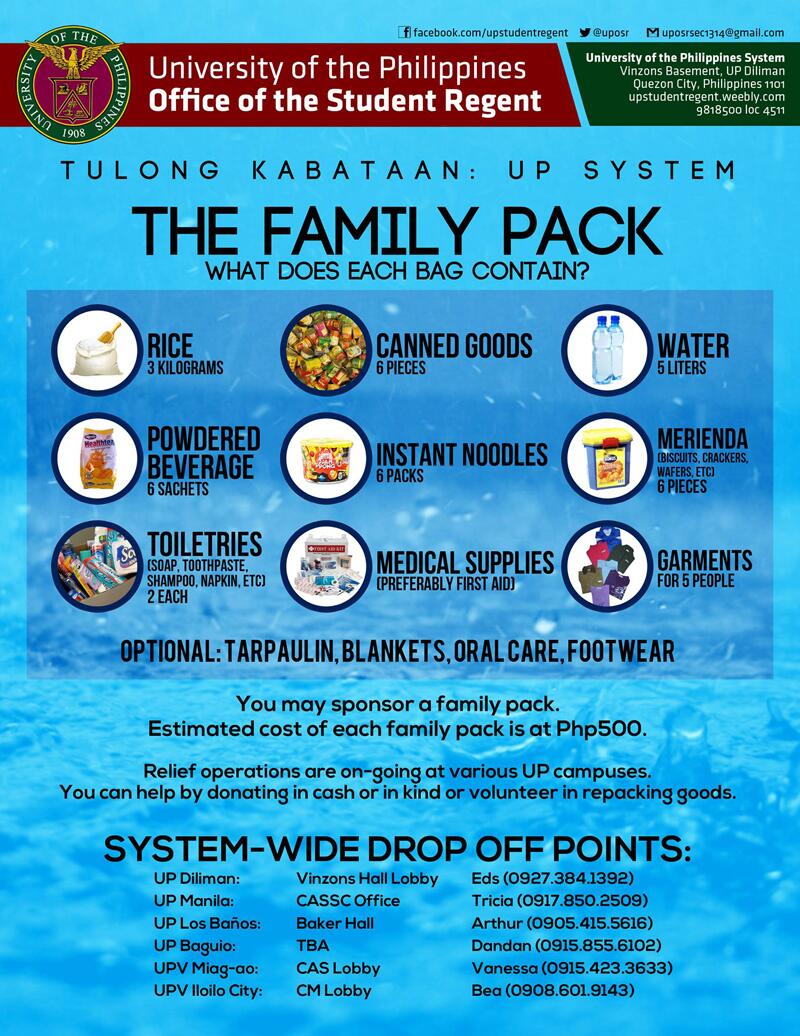 |
| A
poster detailing the Family pack as well as designated drop-off points in the
UP System in the Diliman, Manila, Los Baños, Baguio, Visayas-Miag-ao and Visayas-Iloilo campuses. |
The Ateneo de Manila University's Simbahang Lingkod ng Bayan (a non-partisan, church-based organization) just recently announced its launching of Task Force Bangon Pilipinas (TF). They are looking for monetary donations and human assistance. Donors may deposit in cash or in cheque at the Bank of the Philippine Islands (BPI) Loyola-Katipunan Branch. Interested volunteers may contact Ms. Bernie V. Aton through her cellphone number 0932-8798-752 or through her email address bernieaton@gmail.com
Additional information may be seen in the original Facebook post here.
Postscript
Today, I not only came about these posts and announcements, but I also read through a lot of accounts of the situation in Tacloban. A mother lost her daughter. A father carried his child to the morgue. Two brothers were orphaned. The list just goes on. They are living through a very challenging point in their life.
The storm surges caused by Yolanda swept through many coastal areas, leaving death in their wake. But as relentless as the waves were, so too are donations and relief operations being carried out. The disaster has left behind tragedy and destruction, but it only serves to unite our country in the efforts to aid our brothers and sisters in the Visayas and Mindanao regions.
When they first estimated the death toll, it was a few hundreds. But as the storm cleared that number shot up to over ten thousand dead or missing. It is a tragic tale of loss. But at the end of the day, we have to come to terms with the fact that it's already happened. What's gone is gone. We can't just stop living and grieve for those who didn't make it. The only option is to get back up on our feet and help in whatever capacity we can, and hope for a better future. With our donations, we can help rebuild not just Tacloban, but the rest of the typhoon-ravaged regions.
Together we can make this tragic tale of loss into a tale of loss and survival.
Together, we will rise again. Bangon Pilipinas.
Sunday, November 10, 2013
The Onslaught of Typhoon Yolanda II
An unexpected sequel
As the Philippines recovers from the onslaught of Yolanda, relief operations are quickly gathering volunteers and goods. Unfortunately in some places the supplies are limited due to the damaged roads and cancelled flights; consequently, widespread looting and panic are ensuing in various affected regions. To quote the article:
"Relief workers are yet to reach some towns and villages cut off since the storm.
In many areas there is no clean water, no electricity and very little food."Also from the article, high school Teacher Andrew Pomeda told reporters:
"People are becoming violent. They are looting business establishments, the malls, just to find food, rice and milk... I am afraid that in one week, people will be killing from hunger."
Donations
Tonight, as I was scrolling through my Facebook and Twitter feeds, I came across a few more donation posters and announcements that I feel compelled not only to share and re-tweet, but to collate them into this blog post.
McDonalds
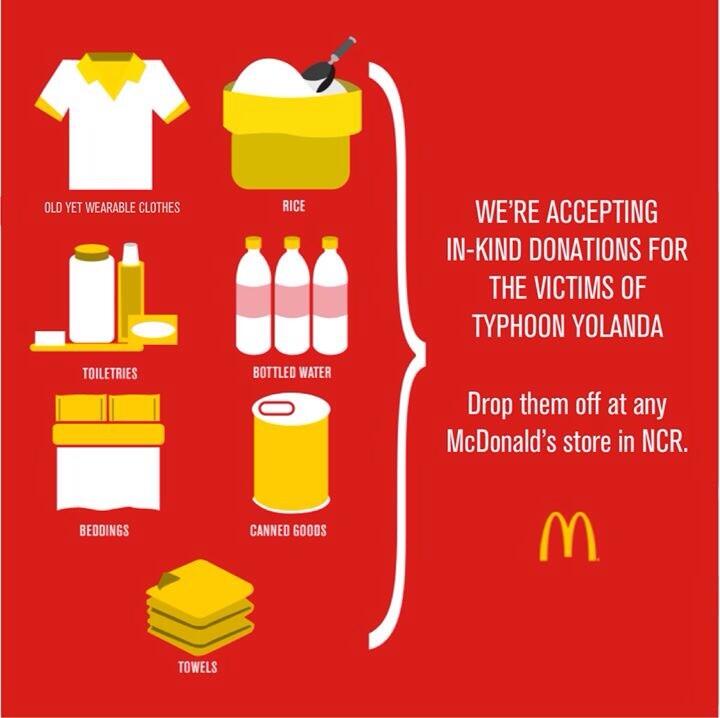 |
| A McDonalds poster released earlier tonight. From: the McDonalds Twitter page |
If you live in the National Capital Region (Philippines) and are able to drop off any of the following donations in the poster, all McDonalds branches are drop-off points.
- Old yet wearable clothes
- Rice
- Toiletries
- Bottled Water
- Beddings
- Canned Goods
- Towels
Please do not feel limited by this list. Donate what you can.
Sagip Kapamilya
Please click the image to enlarge.
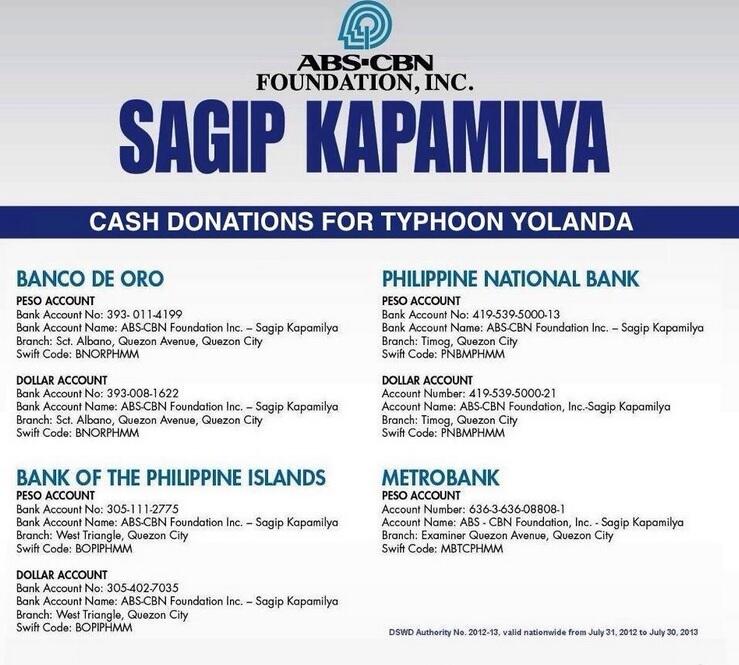 |
| A list of banks that are accepting donations through the Sagip Kapamilya fund. From: the DZMM Teleradyo Twitter page |
For those who wish to donate in cash, the photo above are banks that accept donations through the Sagip Kapamilya (an emergency assistance program) fund. The great thing is they also have dollar accounts. More details can be found in their website: http://www.abs-cbnfoundation.com/sk/
Sanggunian ng mga Paaralang Loyola ng Ateneo de Manila
 |
| Ateneo de Manila University's Sanggunian's poster. From: the Sanggunian's Facebook page |
Please click the image to enlarge.
This body is the Student Council of the Ateneo de Manila University, a university along Katipunan Avenue, Quezon City.
If you live near this area, the council is having a collection drive for monetary donations only (for easier transfer; from November 11 - 15, next Monday to Friday).
Additional details may be found in their original post here.
Yabu: House of Katsu
 |
| A thoughtful poster from Yabu: House of Katsu. From: Yabu's Facebook pag |
Please click the image to enlarge.
A touching poster from tonight on Facebook was from Yabu: House of Katsu's page. 100% of all profits next Wednesday (November 13, 2013) will be donated to the victims of Typhoon Yolanda.
Additional details may be found in their original post.
Preparation
China's Xinhua news agency reported that, in northern Taiwan, eight people were killed as a result of being swept out to sea by waves that are attributed to Yolanda.
In Hainan, six people on board a cargo vessel have gone missing. A typhoon alert has been issued in the said area as well as its nearby neighbors.
The typhoon is in Vietnam right now, as you can see in this photo, also from the BBC article.
 |
| The typhoon track of Yolanda as it enters the Mainland. From: bbc.co.uk |
Saturday, November 9, 2013
The Onslaught of Typhoon Yolanda
Just a few days ago, a new typhoon started making the headlines of most of the newspapers here in the Philippines. It was christened as Typhoon Yolanda, internationally known as Typhoon Haiyan. It made landfall on the eve of November 6 in the Visayas region, placing a number of regions and islands under threat.
Every year, the Philippines is afflicted with several typhoons, causing rains, floods and strong winds. But this typhoon was an extremely large supertyphoon, with a diameter of about 600 kilometers. Making it the largest the Philippines has experienced. Below is an image to help you better picture how big this supertyphoon is and how much damage it has caused.
Since its landfall just this Wednesday, Yolanda had increased in intensity, becoming a Category 5 hurricane, the highest category in the Saffir-Simpson hurricane scale. Those that fall under this category have winds that are greater than 252 km/h. In 2005, meteorologists suggested the creation of a sixth category. This suggestion was put down due to the very few typhoons which would be eligible to be in this category.
According to the Joint Typhoon Warning Center (JTWC), upon landfall Yolanda's winds packed an average of 315 km/h, making it one of the worst typhoons in the history of the world. In contrast, Typhoon Tip (international code Warling), the then-strongest tropical cyclone, had winds with an average of 305 km/h. Imagine that. Had the sixth category been created, Yolanda would be among the few in that category.
As you can see in the picture on the left from newsinfo.inquirer.net, the National Capital Region was not as severely affected as the regions in the south. We in the Metropolis are blessed to have only experienced a signal number 1 (following the Philippine Public Storm Warning Signals System) condition, as detailed by the Philippine Atmospheric, Geophysical and Astronomical Services Administration - Department of Science and Technology (PAGASA-DOST) website:
In the severely-ravaged areas, telephone lines went down, but luckily cellphone signals have been re-established in some of the afflicted regions.
Bohol, which is just recovering from a devastating earthquake just last October, was one of the areas severely afflicted. Aside from the shortage of water and electricity as a result of the natural disaster, relief operations were affected by the supertyphoon and supply lines became increasingly limited, most flights carrying relief goods being cancelled or postponed. According to the news, it will take approximately 2 months for Bohol to have electricity, it's supply coming from an equally-ravaged Leyte.
I recently watched a news forecast from Tacloban City in Leyte, one of the most severely damaged areas, and it was disheartening. A three-story building was destroyed and washed away, a hospital had zero survivors, houses, schools and trees were washed away and dead bodies were floating in the murky water. I was near tears at seeing the corpses being hauled away by grieving relatives and friends. Mind you, these corpses were not just from the water and just happened to wash up, these corpses were also from homes, schools, hospitals and public buildings.
There was even one mother who was in a daze, carrying the body of her dead child. She was wading to a shelter, when the waves tore the body of her child from her arms. It was heart-breaking.
At around 2:30 in the afternoon, Yolanda exited the Philippine Area of Responsibility. But several coastal areas in the Visayas and Mindanao region are experiencing a storm surge. This is characterized by mini tsunamis that, by batch, smash into the land, washing away structures, trees and vehicles. Many residents are trapped in their homes and in public buildings, fearing the relentless waves.
In other areas, citizens have forcefully opened grocery stores and shops, grabbing as many supplies as they can, causing even more panic among the populace.
If you live near the Diliman area in Quezon City, the University of the Philippines Office of the Student Regent and Student Council are accepting donations such as but not limited to the following:
Strongest Typhoon
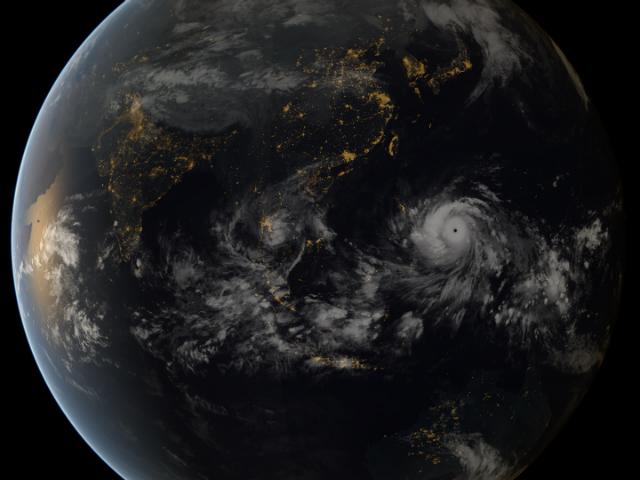 |
| A satellite view of Yolanda. From: gmanetwork.com |
According to the Joint Typhoon Warning Center (JTWC), upon landfall Yolanda's winds packed an average of 315 km/h, making it one of the worst typhoons in the history of the world. In contrast, Typhoon Tip (international code Warling), the then-strongest tropical cyclone, had winds with an average of 305 km/h. Imagine that. Had the sixth category been created, Yolanda would be among the few in that category.
Typhoon path
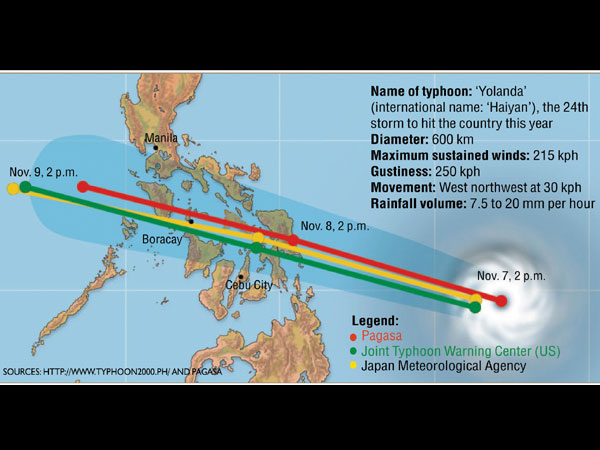 |
| Yolanda's path in the Philippines. From: newsinfo.inquirer.net |
"... only very light or no damage at all may be sustained by the exposed communities."
Intensity and Onslaught
 |
| This gif shows the intensiy of Yolanda as it enters the PH. From: qz.com and ssd.noaa.gov |
Bohol, which is just recovering from a devastating earthquake just last October, was one of the areas severely afflicted. Aside from the shortage of water and electricity as a result of the natural disaster, relief operations were affected by the supertyphoon and supply lines became increasingly limited, most flights carrying relief goods being cancelled or postponed. According to the news, it will take approximately 2 months for Bohol to have electricity, it's supply coming from an equally-ravaged Leyte.
I recently watched a news forecast from Tacloban City in Leyte, one of the most severely damaged areas, and it was disheartening. A three-story building was destroyed and washed away, a hospital had zero survivors, houses, schools and trees were washed away and dead bodies were floating in the murky water. I was near tears at seeing the corpses being hauled away by grieving relatives and friends. Mind you, these corpses were not just from the water and just happened to wash up, these corpses were also from homes, schools, hospitals and public buildings.
There was even one mother who was in a daze, carrying the body of her dead child. She was wading to a shelter, when the waves tore the body of her child from her arms. It was heart-breaking.
At around 2:30 in the afternoon, Yolanda exited the Philippine Area of Responsibility. But several coastal areas in the Visayas and Mindanao region are experiencing a storm surge. This is characterized by mini tsunamis that, by batch, smash into the land, washing away structures, trees and vehicles. Many residents are trapped in their homes and in public buildings, fearing the relentless waves.
In other areas, citizens have forcefully opened grocery stores and shops, grabbing as many supplies as they can, causing even more panic among the populace.
How you can help
In Visayas and Mindanao, areas are slowly getting back on their feet. Supplies and relief goods are trickling in the afflicted areas, but they are not enough.
Bohol and Leyte are just two of the many areas affected by Yolanda. There are thousands of displaced evacuees and millions of pesos worth of damaged property. If you have the capacity, I strongly urge you to donate what little you can, in cash or in kind.
If you would like to make a pledge, please call any of the following relief hotlines:
If you would like to donate directly to the Sagip Kapamilya (an emergency assistance program) headquarters, they are located in #13 Examiner St., West Triangle, Quezon City (hotline: (632) 411-4995). Additional details can be found in their website: http://www.abs-cbnfoundation.com/sk/Bohol and Leyte are just two of the many areas affected by Yolanda. There are thousands of displaced evacuees and millions of pesos worth of damaged property. If you have the capacity, I strongly urge you to donate what little you can, in cash or in kind.
If you would like to make a pledge, please call any of the following relief hotlines:
- (632) 411-0183
- (632) 411-0182
- (632) 411-0115
- (632) 411-0014
- (632) 411-0013
If you live near the Diliman area in Quezon City, the University of the Philippines Office of the Student Regent and Student Council are accepting donations such as but not limited to the following:
- Canned goods or packed food
- Instant noodles
- Rice
- Bottled Water
- Medicine and First Aid
- Clothes and toiletries
- Blankets
The following are posters with additional details. Please click if you wish to enlarge.
 |
| The UP University Student Council (left) and Office of the Student Regent (right) posters for relief goods. |
If you would like to make a donation or be a volunteer for repacking but cannot go to the aforementioned places, please contact your local government officials on how to help.
If you have relatives and friends in need of rescue, please call the DZMM Emergency Hotline (632) 416-6300.
If you cannot donate in cash or kind, prayers are greatly appreciated. Please, pray for our countrymen.
Sources:
Sunday, October 27, 2013
Of Jingles and Promises
This is officially my first post that is not an academic requirement. I apologize for not updating soon enough; I've been quite busy over the break.
Here in the Philippines, this coming Monday is the nation-wide barangay-level elections (except for the earthquake-ravaged Bohol and the siege-recovering Zamboanga). The Philippine barangay is the rough equivalent of a district or village, and is the smallest administrative unit. Basically, voters go to precincts and vote for a barangay captain and seven barangay kagawad or councilor.
I'll leave you to ponder on that, and hope for the best this coming Monday.
Elections
Here in the Philippines, this coming Monday is the nation-wide barangay-level elections (except for the earthquake-ravaged Bohol and the siege-recovering Zamboanga). The Philippine barangay is the rough equivalent of a district or village, and is the smallest administrative unit. Basically, voters go to precincts and vote for a barangay captain and seven barangay kagawad or councilor.
Jingles and Promises
Barangay elections are held every three years. And as is the status quo here in the Philippines, every campaign has its campaign jingles (spoofs of different songs, mostly English songs; Bruno Mars' Treasure, Justin Bieber's Baby, Gwen Stefani's The Sweet Escape are some songs of note that have been used). These jingles range from entertaining to downright annoying, especially when the speakers are on full-blast on a would-have-been peaceful weekend morning. But I digress.
Every campaign period these candidates parade themselves to the people, loudspeakers and megaphones blasting out their platforms and promises of progress, clean governance and flowery words. Confetti usually in the colors of the party being scattered on the roads, traffic congesting at each street and the angry blaring of car horns usually drown out those platforms of promises.
Literacy
Thus far my blog post sounds very pessimistic. It is not my intention to antagonize the candidates for kagawad, nor is it my intention to discredit their campaign strategies. My intention is to send this message to all Filipinos who will vote this coming Monday: VOTE WISELY.
According to a 2011 study by the National Statistics Office (Philippines) basic literacy in the country for men (aged 10-64) was at 95.1%, for women (aged 10-64) it was 96.1%. Functional literacy, or the ability to read, write, understand and apply words and numbers, was 84.2% for men and 88.7% for women. Not so big a drop, right?
Numerically, at least.
And yet every election always ends up with a corrupt official in power, manipulating public funds. Somehow one of these buwaya (literally 'crocodile'; slang term for corrupt official) always ends up an official, amassing wealth and power while millions remain starving, homeless and jobless. Hearing about it is disturbing. Actually seeing the effects of corruption in the slums of the Metropolis? It's disgusting.
Ah, Education
If more funds were used wisely and efficiently for the educational sector, so many people would be better equipped to screen which promises are just flowery words and which are legitimate goals. Maybe then, the vote and voice of the educated would not be overwhelmed by the vote of the less-privileged who are easily-swayed by promises and flowery words - and oftentimes, money.
It's not enough to just demand that more funds be allocated to the educational sector, because that sector currently enjoys a large cut of the annual budget (which could use more money, to be honest, but that's not the point). Money wasted on unnecessary projects could instead be used to invest on research facilities and books for school children.
I'd like to share something I heard last night at mass. It was called the "Prayer for Voters" and it was shared to us by our priest during the concluding rites:
"For it is by voting wisely that we may receive the seeds of true democracy."Yes, I cannot stress that enough. Not just in the Philippines, but in all countries that allow their citizenry to vote. It is a right to vote. But it is also a duty which must be exercised responsibly. One voice can make or break a candidate's position. One voice can dictate the future of thousands or even millions. One voice can make a change.
A Postscript for Candidates
Of course this blog post would not be complete without a message for the candidates themselves.
To all candidates, barangay-level or not, please keep this in mind: You have been given the mandate of the people, please do not waste that trust. A congratulations to all candidates for giving your all in this campaign, I wish you all the best of luck and may the best man win. Always keep in mind that it is the people who can bring you to power, but it is also they who can bring you down.
Sources:
Wednesday, October 16, 2013
Reactions V ...sort of
A 5-part blog entry
This is officially the final required blog entry for the semester. It was originally intended for our first exposure trip to our respective teaching sites, but due to an unfortunate conflict of events (the kids' classes being cancelled, for one) the trip was moved to next semester, and as such this entry will be about our session last Monday. That disappointed me a bit, to be honest; but hey, that's life!
Warning: Spoilers ahead.
Instead of our intended trip we had another film-showing. Our professor left us with this question before playing he video: What is your center? I thought it was Mulan, to be honest (but that quote would have been "find your center"). The film was Rise of the Guardians, a 2012 American 3D computer-animated film featuring the 'guardians' of certain aspects of childhood, and of children: Santa Claus, the Easter Bunny, Sandman and Tooth Fairy, and their newest addition, Jack Frost, as they battle the Boogeyman Pitch Black.
The story presents an interesting situation for immortal beings in general. For them to be "seen", they must be believed in. But once a spirit becomes a guardian, he must be believed in by children and once this belief is established he must maintain it, otherwise his power will wane. Such is the dilemma of Jack Frost, who has struggled for the past three centuries trying to make children believe in him.
The scene that opens up the central question of this blog post is when Jack Frost is called to the North Pole and has a private conversation with North, better known as Santa Claus.
What is your center?
Here I'm equating the concept of 'center' with purpose. What is one's purpose? The center affects the whole, and the whole those around it.
Teachers all over the world have different reasons for entering the profession - the desire to inspire a student, collect resources, earn extra income - no matter the motivation, the teacher's center affects the teacher and his students. That's a big wave cast by one tiny droplet, if you look at it that way. As an aspiring teacher, I asked myself North's question. What is my purpose? Why do I want to teach?
I've always wanted to teach - not necessarily be a teacher, but to simply teach. I've had this dream since I was little where I share what I know and make an effect on someone, and that someone passing it on and on. Very Humanistic, I know. But the beauty is when, one day, you see that spark in a student's eyes that say I've got it. When that happens, I imagine that I will feel the best kind of satisfaction. And when, years later my student is out in the world carving out a name for himself, I can point to him (or a picture of him, whichever works) and say, That's MY student.
Until then I'll build myself up on that dream and know that I have my center to guide me: sharing.
The story presents an interesting situation for immortal beings in general. For them to be "seen", they must be believed in. But once a spirit becomes a guardian, he must be believed in by children and once this belief is established he must maintain it, otherwise his power will wane. Such is the dilemma of Jack Frost, who has struggled for the past three centuries trying to make children believe in him.
Center I
 |
| North explaining the concept of a guardian's 'center' to Jack Frost From: disneyscreencaps.com |
"... This 'wonder' is what I put into the world! And what I protect in children; it is what makes me a guardian. It is my center. What is yours?"
--- Santa Claus to Jack FrostAnd because I don't know where to place this trailer, and to make sure it doesn't spoil a carefully-outlined blog entry, here you go: (a big thank you to the Youtube channel DreamworksAnimation for this!)
Center II
Here I'm equating the concept of 'center' with purpose. What is one's purpose? The center affects the whole, and the whole those around it.
Teachers all over the world have different reasons for entering the profession - the desire to inspire a student, collect resources, earn extra income - no matter the motivation, the teacher's center affects the teacher and his students. That's a big wave cast by one tiny droplet, if you look at it that way. As an aspiring teacher, I asked myself North's question. What is my purpose? Why do I want to teach?
I've always wanted to teach - not necessarily be a teacher, but to simply teach. I've had this dream since I was little where I share what I know and make an effect on someone, and that someone passing it on and on. Very Humanistic, I know. But the beauty is when, one day, you see that spark in a student's eyes that say I've got it. When that happens, I imagine that I will feel the best kind of satisfaction. And when, years later my student is out in the world carving out a name for himself, I can point to him (or a picture of him, whichever works) and say, That's MY student.
Until then I'll build myself up on that dream and know that I have my center to guide me: sharing.
Welcome to the Dark Side, it's [going to be] awesome
An important message my professor told us to cap the semester is empowerment.
The goal of the Literacy Training Service (LTS) Program is to empower children by developing their literacy. Not just basic literacy, mind you, but functional literacy; the ability to read, write and practically make sense of what you know. For the rest of the year, we must not forget our goal of empowering kids so that they have a better chance at life.
Being a teacher is going to be challenging, because the program is aimed at kids who have a harder time with reading. But I know it's going to be worth it. Because, as my professor emphasized, our goal is world domination.
I kid.
 |
| A cropped-out screencap of the e-mail from our professor before our first meeting |
See you again soon,
Daniel.
Monday, October 14, 2013
Reactions IV
A 5-part blog entry
Up until last Monday, our Literacy Training Service (LTS) sessions consisted of seminars and activities. When I entered the classroom last Monday, though, the set-up baffled me. Our relatively large classroom was suddenly divided into smaller sections, with chairs and tables being set-up facing different directions. I doubled-back and checked if I had accidentally walked in on the wrong classroom, but I got the right one. Was there an event that coincided with our class? Were classes cancelled for the day and I had just forgotten to check my e-mail? Fortunately though one of the people setting up - my professors - sees me and with an amusing expression invites me in."Pick a spot," she urges me. I look closer at the room and quickly figure out that the room has been divided into three smaller sections, creating a simulation of classrooms. I chose one and sat down on one of the already-set chairs.
As my equally-confused classmates eventually came in and chose their own spot in their own "classroom", one of the women setting up approached each of us with a roll of masking tape and a marker, asking our names and making name tags for everyone.
Kid for a day
It turns out the women who were setting up were actually upperclassmen Education majors who volunteered to be our "kindergarten teachers". I can say it was amusing to play a kindergarten kid for a few hours. We had a very interactive story-telling and a few games and activities after that, like vocabulary exercises and fill-in-the-blank activity sheets and posters. You could really tell that our volunteer teacher put a lot of effort to make all the interactive objects and other teaching paraphernalia. I wish I had taken pictures of some of the simple string mechanisms she used in the vocabulary exercises.
Play time
Our professor's point was that no matter what a child was playing, playing in itself is important for development. They help a child learn teamwork (more the traditional games than those on the phone), play by established rules, and overall, develop a child's sense of his own abilities.
It's interesting to note that she also pointed out how telling a child to keep silent, to sit erect, and to follow all that boring class decorum were actually unnatural for a child. It makes sense, though; not letting a child develop by being his natural (to an acceptable and reasonably tolerable point, of course) self and letting him explore is limiting him in an alien environment.
The four-pronged approach
What we experienced, continues our professor, was a combination of study and play: the Four-Pronged Approach. Simply put, said approach consists of four parts to encourage a child not only to read but to love to read. I found an interesting pdf online by Raidis Laudiano that describes it in detail: http://www.jeanettepatindol.com/uploads/3/5/3/0/353097/the_four-pronged_approach.pdf
- Genuine Love for Reading: The first step is establishing an interest for a piece, say, a story, in a child. This stage is basically where you take the child on a very guided tour of the story and the words. Vocabulary, plot and other elements must be clearly detailed to the child.
- Critical Thinking: The children are asked the motive question. From this, the discussion flows and explains the entire story, each time asking the child more questions until they fully grasp it.
- Mastery of the Structures of the Language: In this third stage, vocabulary, attention span, and listening comprehension are developed. Vocabulary exercises are a perfect tool for grasping new words, while making it fun for the kids helps them focus more on the goal - appreciating the story.
- Transfer Stage: This is a stage I like to refer to as a 'transcendence stage'. This is sort of a culmination of the approach. Worksheets are helpful in letting a child piece the story together according to how they understood it. It reflects how much a child has learned and, hopefully, will lead to the child learning to love to read.
The session left a very deep impression on me. There was so much effort poured into a relatively small amount of time, but it would have a large impact on a child. I guess you could say this was an inspirational and re-affirmation point for me. Seeing how willing and enthusiastic our volunteer teachers were, and at the same time how fun the activity was, only deepened my desire to make a change in a child's future. And I guess that's why most of us become teachers - the desire to make a change and to empower a child with knowledge. It's a noble profession, yes. But it's sure to be a rewarding one.
Subscribe to:
Posts (Atom)